Dont't worry if it doesn't work right. If everything did, you'd be out of a job.



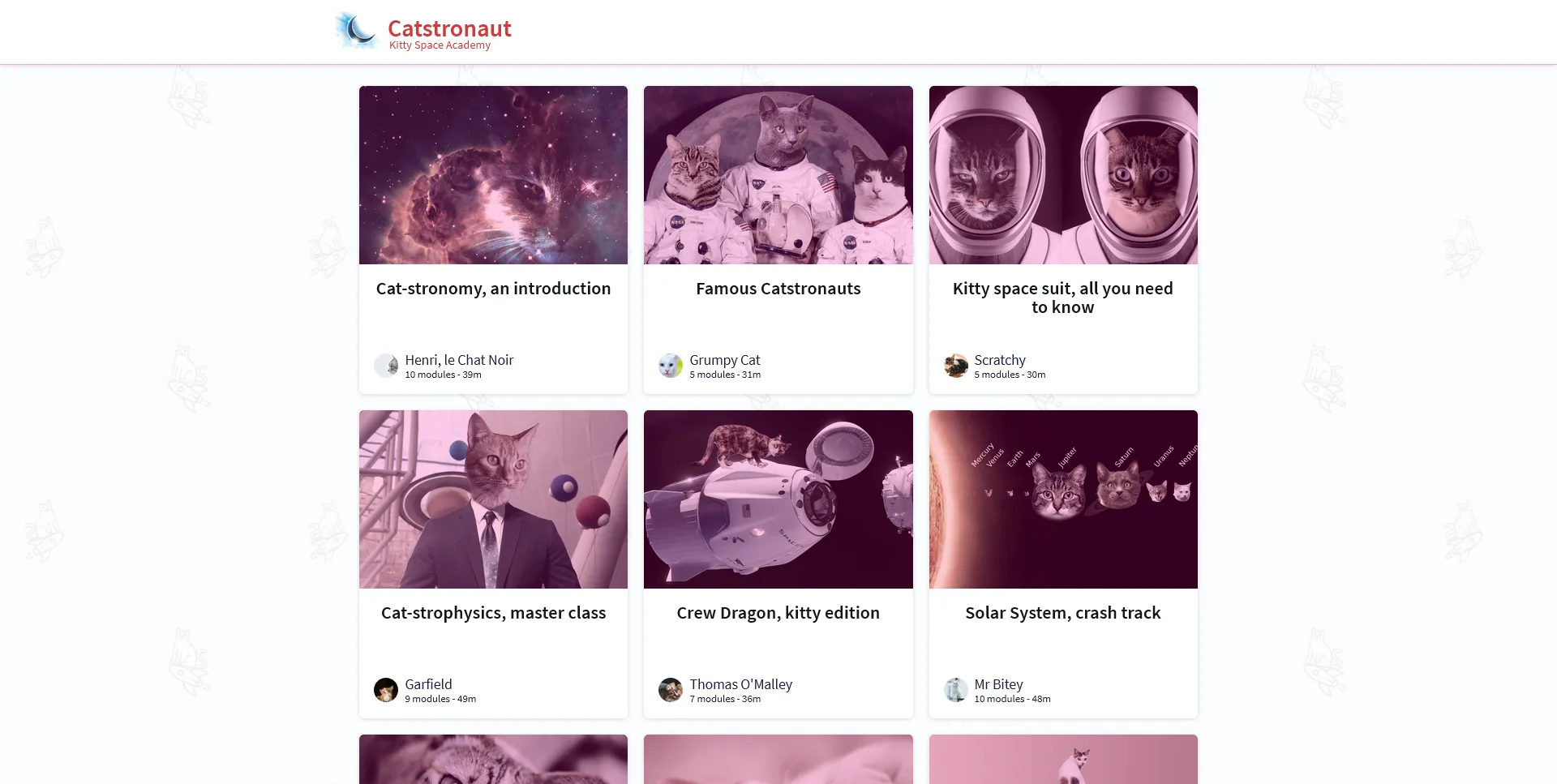
Kitties in Space
Frontend
To build this feature, we'll use a "schema-first" design. That means we'll implement the feature based on exactly which data our client application needs. Schema-first design typically involves three major steps:
1. Defining the schema: We identify which data our feature requires, and then we structure our schema to provide that data as intuitively as possible.
2. Backend implementation: We build out our GraphQL API using Apollo Server and fetch the required data from whichever data sources contain it. In this first course, we will be using mocked data. In a following course, we'll connect our app to a live REST data source.
3. Frontend implementation: Our client consumes data from our GraphQL API to render its views.
One of the benefits of schema-first design is that it reduces total development time by allowing frontend and backend teams to work in parallel. The frontend team can start working with mocked data as soon as the schema is defined, while the backend team develops the API based on that same schema. This isn't the only way to design a GraphQL API, but we believe it's an efficient one, so we'll use it throughout this course.
Vestibulum ante ipsum primis in faucibus orci luctus et ultrices posuere cubilia Curae; Pellentesque suscipit.
Tiled say decay spoil now walls meant house. My mr interest thoughts screened of outweigh removing. Evening society musical besides inhabit ye my. Lose hill well up will he over on. Increasing sufficient everything men him admiration unpleasing sex.
- The schema-first design approach and its benefits
- Schema definition language (SDL) fundamentals
- Build a GraphQL API using Apollo Server 3
- Use mock data to get up and running quickly
- Build and run queries with Apollo Explorer
- Send queries and display data using Apollo Client 3